Co-op horror gameThe Outlast Trialshas just released one of its biggest updates, which is no small feat considering the game’s progress since Early Access. Project Lupara introduces the game’s first new Prime Asset, Franco, who is also the game’s first ranged enemy and drastically alters how players will think about the environment. Also included with the update is an all-new difficulty settings system that accommodates casual solo players and hardcore veterans alike, and there’s even a daily and weekly task system to give players some structured goal setting.
Game Rant sat down withThe Outlast Trialsgame director Alex Charbonneau to discuss all the new content in the update. He spoke about how the team is thinking about its solo audience, how they approach adding new Rigs, enemies, and maps, and some ideas the team has for a potential future game mode.This interview has been edited for brevity and clarity.

Balancing The Outlast Trials for Co-Op and Solo Players
Q:The Outlast Trialsis at its best in co-op, but series fans may be more accustomed to playing solo. What challenges do you face as you try to balance the game for both audiences?
Charbonneau:It’s funny you spotted that because not many people mention it. I think a lot of our users come for our co-op, but we do have an audience that is old-schoolOutlastandOutlast 2fans, and they want to playOutlast Trials. From the very beginning, it was always clear that this also needed to be a perfect solo experience, as much as possible. That’s why the entire game is fully playable solo, and this was always something we wanted to respect.

However, after releasing the game and watching people and looking at the data, we realized it was a bit tedious and sometimes challenging for solo players. Patch after patch, behind the scenes, we’ve been tuning the game more and more for solo players who encounter difficulties while they are playing.
Ultimately, we always wanted to hold the players by the hand with the programs in the sense that it’s Murkoff who’s creating the program with the Trials, so they should be the ones in charge and also in charge of the difficulty curve, so to speak. But we concluded that our audience is vast. We have people who just pick up and play and want an intense horror experience, and we have other players who just want an extreme challenge.
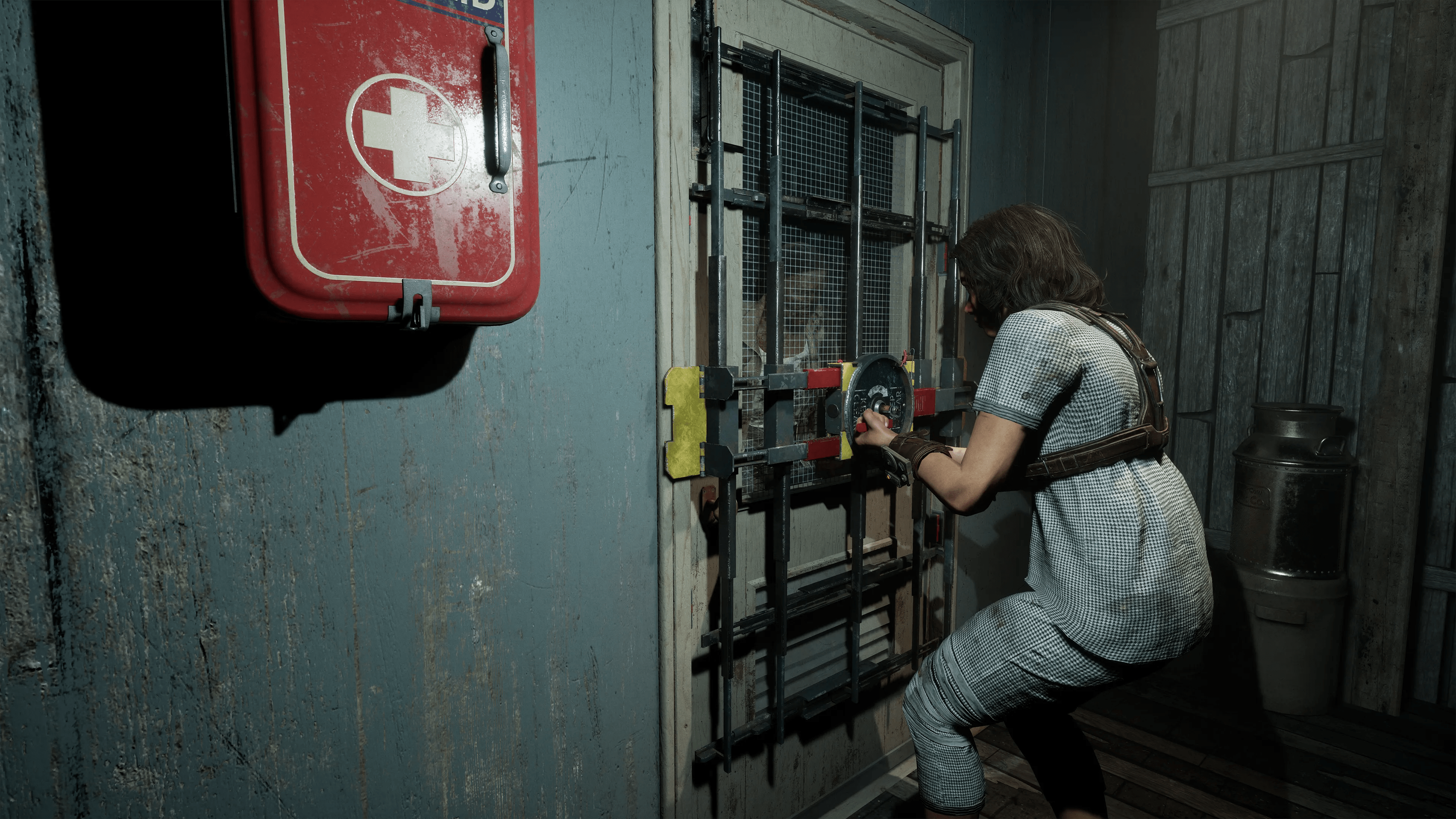
We decided that it would be better to let the player decide between a bunch of difficulties. The difficulty that we call “Introductory” is the easiest way of learning the Trial, so it might not be for everyone because it’s way easier. It’s more like a story mode if you really want to enjoy the trial and learn the objectives. When you’re ready, you could increase the difficulty based on your tolerance to pain if you want.
To answer your question, solo has always been a feature we wanted to have in the game, and we always want to respect that. You also asked, “What’s the challenge of designing for both situations?” One thing we didn’t want is to have a solo player play with bots. Many co-op games turned to this solution, and that’s a cool solution in those games. For us though,theOutlastexperience is about you alone, so we always wanted to respect that. The game does tune itself a little bit considering the amount of players, but we also discovered that when you’re alone, you’re more in control.

If you’re with another player or a group of players, they can f*ck up. You’re stealthy, but your friend makes a mistake and runs in front of you and now suddenly you have an enemy you have to deal with. Naturally it gets harder. Also, with more players, it’s more chaotic, which also creates more memorable moments. It’s a fun game. People are screaming and laughing, and we love seeing it.
I’ve been playing with a good friend of mine who’s not a huge horror fan, and I love those moments where one of us accidentally screws the other over by shutting a door or alerting an enemy. I’m looking forward to the new Barricade Rig bringing more moments like that.

Charbonneau:The Barricade became a natural choice for a new Rig for us because we’re watching a lot of new players who struggle with completing an objective because an enemy always comes in and patrols around and players have to go away and come back. The rig was a natural thing for us to add because it’s this tool where you can say, “Okay, we’re going to delay the enemy for a moment while we finish the objective.”
It’s more situational as a tool than the Stun Rig or various other Rigs, but it has its uses and it’s impressive to see how players are using it. I cannot wait to watch the streams of our players. When I say “players” internally, we notice how we use it when we play, but I cannot wait to see what real players are going to do with it.

Q: I don’t how much you can talk about this, but did you ever bounce around ideas for Rigs that didn’t quite cut it for some reason?
Charbonneau:We have a bank of ideas for enemies, Trials, Prime Assets, and game modes. In terms of Rigs, there were a bunch of tests that maybe at the time didn’t really work, but now that the foundation is solid and we know our game loop and everything, they might have a comeback in the future. We don’t want to introduce too many new gameplay elements at once, so it’s certainly stuff we’re going to introduce in future updates.

Q: It seems like a lot of this update was based on player feedback. The team is very open on Discord. Was there any feedback in particular that really guided your approach to this update?
Charbonneau:It’s true. We have the privilege of being a small studio and our proximity to the players is key to our success. It’s critical for us to listen to them, and we take action very quickly. There’s one layer between the players and us, and it’s the screen. It doesn’t go through a committee of people deciding whatever. We watch people and we have some data, so we can see, “Oh, it’s true, they have this struggle at this point in the game,” or “They would like this thing” and so that guides us a lot.
With feedback, we fear that something could be too easy or too hard, so it might sound like a small thing to add a difficulty setting to a game, but it is game-changing in our situation. You mentioned your friend may not be ahuge fan of horror games. A lot of people might have skippedOutlast 1andOutlast 2because it’s too intense for them. They’re like, “Oh, I dropped within the first 10 minutes.” But now you’re able to bring your friend and you can share the experience together, so it’s truly important that we nail it so that even the “noobest” person has a good time.
Also, our thing withOutlastis that it’s very pick-up-and-play; you don’t have to be good atCounter-Striketo enjoy our game. It’s not about shooting, it’s about acting naturally in the game, hiding, running away, making mistakes and trying to fix them, understanding the objective, and things like that. We really wanted to make sure that any player would be able to jump in.

After that, there’s the regular balancing thing stuff. People are going to say a Rig is too powerful or not powerful enough, so we pay attention to that and we take actions very quickly after. I guess the biggest feedback we always receive is that people want more stuff. We attempt to give them more stuff, but it takes time to build new Trials and new enemies. It takes time, but that’s the number one feedback and that’s our focus. We’re trying to provide as many new things as we can with this release, and I think it’s a pretty packed update with a lot of cool stuff.
Outlast Trialsis a challenging game, but it’s easy to play. My friend and I had the controls and mechanics figured out in just a few minutes, while the difficulty came from solving each objective and staying alive.

Charbonneau:We didn’t want the players to struggle with the game mechanics. When you hold the controlleror mouse and keyboard, we wanted it to feel very natural, like you said. In terms of what creates intensity, it’s to keep the players on their toes to surprise them. That’s where it can become a bit more difficult.
There might be many layers of things at the same time, like enemies chasing you, you’re out of battery, you have to complete that objective, you’re not sure where the generator is, and it’s dark. So it’s more of those elements that create the difficulty. It was important for us to make sure that you don’t struggle with the controls or the core mechanics of the game.
The Outlast Trials' Escalation Therapy Roguelike Mode
Q: The update is also introducing a roguelike mode, Escalation Therapy. How does that play out?
Charbonneau:It was a huge revelation. To be honest, we wanted to do this type of infinite mode for a while; it’s just that you need a certain amount of content to be able to do it. We felt that now was a good moment to introduce that. Internally, when we play every week, it’s the number one thing people want to play. It’s so fun because it’s like a mixtape of the content because it’s random. There are random Variatiors, and just like roguelikes, before you enter a Trial, you’re going to be offered a selection of upgrades and you can only pick one. Your loadout is building up as you’re going through the Trials, and it creates moments that are so exciting and unpredictable.
Also, one thing that players have been asking for in our game is that when you’re killed in a Trial, you return to the sleep room, and then you can try again and keep your progression. We had people asking fora permadeath situationin our game. In the roguelike, it’s not going to delete your character–you’re going to keep her progression in the normal Trials–but in this game mode, when you start it, you start at level one, you build up your character, and you go as far as you can.
It’s also a nice way to discover a lot of the upgrades and the Rigs that some players might have never really noticed before, or they’re not there yet to unlock them. It gives them a sneak peek at what the game has to offer. We see it as our first iteration of this. After it is released, if people really like it, we’re going to listen to the feedback and, for sure, it’s going to evolve over time.
Q: Something I like to see in roguelikes is meta-progression where players run a little faster or have more health in their next run. Is that something the team considered for Escalation Therapy?
Charbonneau:You’re nailing some excellent points with theroguelike mode. We did think about that because, in our first iteration internally, it would only offer you things that you would have unlocked permanently in the sleep room. This was interesting, but it limited the choices quite fast for or early on in the game. After that, we tried it with the entire loadout available, and it offers you things randomly even if you don’t own them in your main character progression. We decided to go with that just because it’s a lot more fun and much more accessible for everyone at first.
One thing we’re toying with in the future is maybe we could do an “Escalation mode hardcore version” or something like that, where maybe there’s more connection between your permanent character and what happens in Escalation. To be honest, it’s super open. We’re going to see how people react, listen to the feedback, and for sure we’re going to keep iterating on this.
Q: How does randomization play out? Do the environments themselves change?
Charbonneau:The Trials are random among the pool of Trials we have in the game. We have 20 Trials and then we apply Variators. We have many, many Variators that sometimes drastically change the way you do a Trial. The layout itself is never going to change–we’re not there yet–but you’re going to revisit the Trials and MK Challenges that you are familiar with, but because of the modifiers, you have to play differently.
Also, because the loadout you have is unique to your run, you might have to make decisions or behave differently than you usually do. We’ve tuned the difficulty curve because we didn’t want to slap someone right at the first Trial. At first, it’s a random Trial with just one or two Variators, and as you go on, there are more and more Variators and enemies are stronger.
Internally, I think the maximum Trial is around eight or nine because it gets really hard. I truly cannot wait to see streams of players attempt to go as far as they can, because I’m going to be surprised how far they’re going to be able to go. But ultimately, they could play for a full week. There’s no limit, it’s endless. Maybe someone will doa marathon on Twitchfor three days straight of just one escalation. We’ll see.
Q: Speaking of surprises, has there been anything that players have pulled off in the game that has surprised you?
Charbonneau:Generally speaking, it just gives such a fun spectacle when you watch players because it’s multiplayer and it’s very systemic. We don’t control a lot. Once the players are playing, we cross our fingers that they have a good experience. The timing of the enemies or patrolling or anything they do is completely systemic. We don’t know what’s going to happen, and I would say my favorite moments are the first time someone experiences psychosis. They get all f*cked up, the voice chat changes, they’re freaking out, they don’t know what’s going on, and they have all those hallucinations.
Also, the impostor is always very funny for new players. I’ve seen people get so confused. They’re like, “What?! It’sa PVP game? Are there weapons like this in the game? Who is this guy?” After a few minutes, they realize that it’s the game that fooled them, and it’s so funny to see. Those were moments that were very memorable for us.
The impostors really confused my friend and I at first. It had their name and I thought, “Dude, why are you stabbing me?”
Charbonneau: There’s one or a few letters that can change in the name, but to be honest, in the heat of the action, you might never notice. Sometimes it’s just this coincidence, but it’s a perfect match. You’re talking to your friend and the impostor is coming near you and you’re certain that it’s your friend, but suddenly it’s not. He’s like, “No, I’m elsewhere. What are you talking about?”
I was scared for a second because we don’t want to piss people off. I remember seeing one stream where the guy was like, “What is this?” He was very surprised and upset, but soon after, it changed when he realized that this was an NPC. Those are cool moments for us to watch.
Q: Speaking of the game’s villains, you’re introducing Franco with this update who is a very disturbing, unique character. What was the process like going from idea to implementation?
Charbonneau:There are multiple angles to the creation of a Prime Asset. The Prime Assets inOutlast Trialsare like our main characters. They’re like a Joker or a major villain, so there’s the whole artistic side and the narrative side to it.
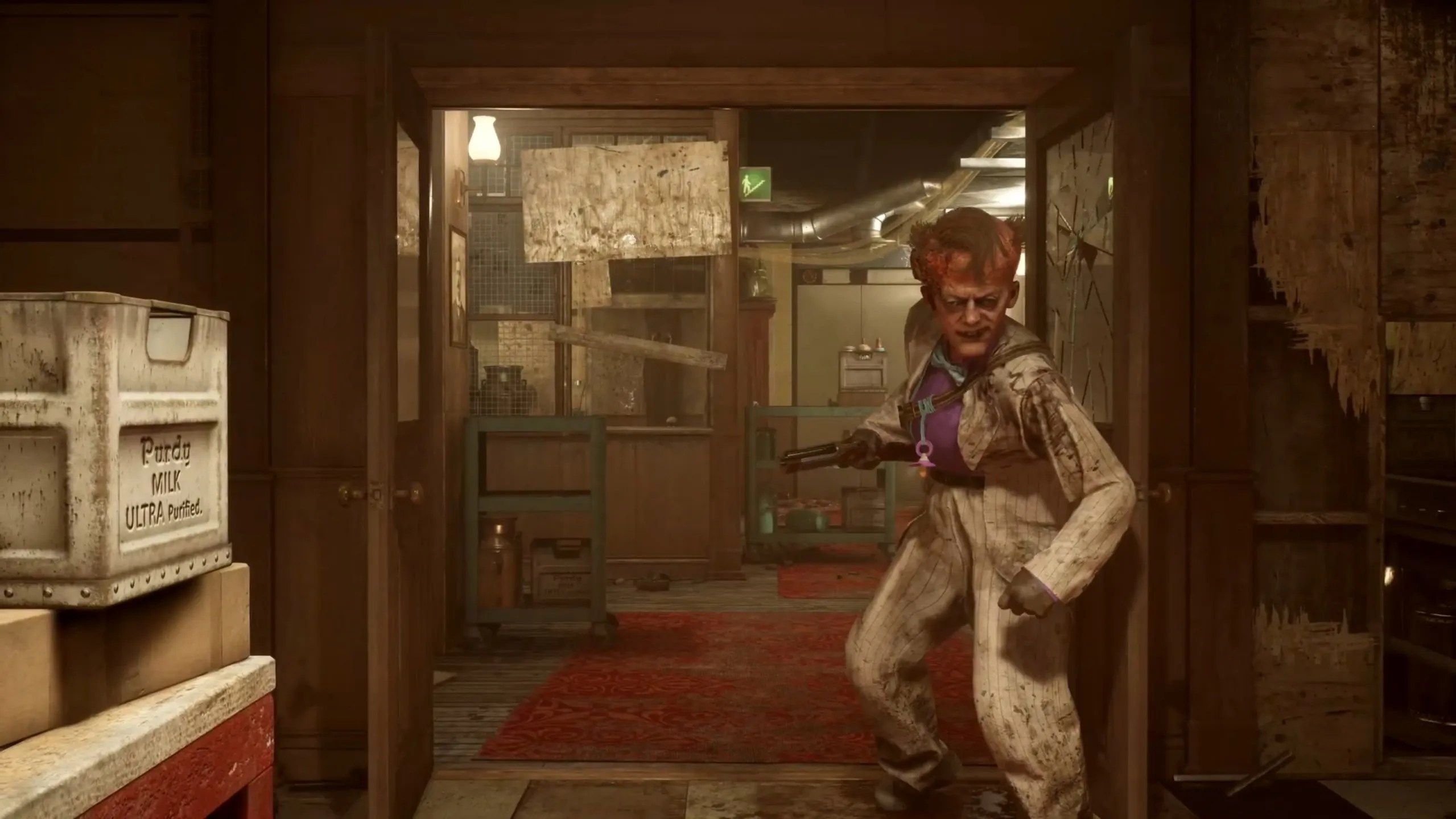
As far as gameplay, we wanted to bring something completely fresh and new to the game. With the fact that there are zero ranged weapons in the game and people got used to that, we felt that now was a good moment to introduce this kind of enemy and weapon just because it changes the way you play completely. Everything you assumed was safe is not anymore. Running away in a corridor, you’re basically exposing yourself. Suddenly you have to take cover behind the obstacles and objects, which is something you’ve never done before unless you wanted to play stealth, but now it’s for your survival.
When the update releases, there’s a new Trial with Franco, but we’re also going to be running a special event for the first month where Franco also appears inany other Trial. Even in Trials that you are very familiar with, when Franco shows up, it’s completely different. This is the first time we’ve added a new Prime Asset, so it’s going to be very interesting to see how the players react.
Q: Was it difficult tuning a ranged enemy in the game and trying to determine how accurate he should be or how much damage he does so that it feels fair?
Charbonneau:That’s a valid point. We’re not a shooter game, so a lot of the mechanics didn’t exist before. There were no projectiles of this type, there was no recoil, and there were no bullet tracers. None of this was in the game, so we had to build it just like if we’re building an enemy inaCall of Dutygame, let’s say. It’s something that we’re familiar with due to our experience elsewhere on other games we’ve done in the past, but for this game specifically, we had to start from the bottom and then build the whole fact that there’s now a ranged weapon in the game.
Q: Did you have to adjust the level design of Trials to accommodate Franco’s gun?
Charbonneau:It was part of the balancing. One rule we have is that every Prime Asset needs to be working correctly in any Trial, so when we were balancing his range and his bullet spread and things like that, we paid attention to the metrics we already had in the game. Obviously, there are moments where he gets an advantage, like I said if it’s a long straight corridor or open area you have to be more careful. It’s also a cool twist because normally you will not care if Coyle is at the other end, he sees you and you can run away. Butif Franco sees you, he is going to shoot you.
It works very well, to be honest, in any Trial even outside The Docks which is the new Trial. It’s impressive how when he’s around his presence is very strong. It’s very intense. Basically, the rule we have is, even in the future as we add more villains in the game, we want to make sure they can be used in any Trial.
Q: Speaking of rules, how do you decide what makes a good Prime Asset? What do you look for when determining if the character is a good fit for the game?
Charbonneau:Well, we have no choice. We promised it, so we wanted to ship it. [Laughs]
There’s a lot of iteration internally from the very beginning. As we gain experience with the game, as our foundation is solid now, and we have a large community, we’re in a good situation to move forward. Whereas before the game was released, it was a bit more obscure. Are they fun? Are they challenging? Things like that.
For example, inthe last update we had Prime Time, which was a special event around Mother Gooseberry and Coyle. We’ve added the fact that their attacks now do a special ability, like Gooseberry can cause bleeding or Coyle can disable your Rig. With Franco, we felt like just the fact that he has a ranged weapon is good enough of an effect, but it’s getting clearer and clearer how we should be building them and how they can change the way people play in the various Trials.
I would say it’s challenging because we want to move fast, we want to provide new content to our players as fast as possible, but at the same time, we want to verify it’s well done and not buggy. But that’s part of the challenge of making video games.
Q: We’ve talked about some of the headliners of the update, but are there any things about the update that you’re particularly excited about?
Charbonneau:There’s an ending in the game, which is something that we feel is special aboutOutlast Trials,because normally live service games don’t have a conclusion or ending. For us from the beginning, it was important that the player had a goal to achieve even though it’s multiplayer, and you can play every day if you want. In this update, the final Trial is different from what we had before. There’s also a new conclusion.
Other things might be seen as smaller, but they are significant. We have a new Task System, so this is another thing people wanted. “We love the game, we love the Trials, but we need more Trials, more stuff, more goals.” So now, when you go into the game, Murkoff is going to have tasks for you to accomplish every day and every week. We also have other tasks for onboarding, teaching the player a few of the mechanics in the game. Those are going to be refreshing every week, which is cool.
It comes along with the new Catalog System, which is basically another thing players wanted because we have a lot of nice cosmetics in the game, but the way we were giving them away was through random rewards after you finish a Trial. It didn’t do the best job of exposing some of the cool things you have in the game. Instead, the Catalog is basically like window shopping: you go into this menu, you can see pages of all the stuff that are there to be unlocked, and we want to add more catalogs every season.
This one comes with the Project Lupara catalog, which is a bunch of new cosmetics, and then in the future, we want to add more and more. Once we have a seasonal catalog–that’s what we call them–they’re there forever, so there’s no time pressure.It’s not FOMOor anything like that. Players can take as much time as they want to unlock the stuff in it. I think it’s going to hook them for a longer amount of time. Just internally, booting the game while reading the tasks, going into Escalation, trying to complete the tasks, going to pick up your stuff in the catalog, it’s a great loop.
The Outlast Trials As Live Service Game
I agree that sounds like a strong loop. You don’t expect a horror game to hold your attention in this way. I could play this game all day like I wouldDestiny.
Charbonneau:One thing I want to say is we never could have predicted that this would becomea live service game. The only reason we’re here today is because people demanded that. No joke, we had surveys where we were asking people “How often would you play this game?” and my expectation personally was maybe once a week at best, maybe once a month when they have friends around. No, the majority of the answers were “Daily.”
We have a lot of pressure. We had comments from people saying, “When I’m not in the sleep room or in my cell, I don’t feel good. I want to go back in the game.” I’m super impressed as well, because as you said, this is a very specific kind of game, but our players want to have a reason to come back daily and weekly. That’s what we’re giving, and no one’s pushing us to do that for business reasons. It’s truly from the developers listening to the community. They just want more, so those systems work well. I think people are really going to enjoy them.
You raised an interesting point there. This is a unique case because so many games are built from the ground up to be live service games for business reasons, while you did it because players asked for it. This is almost the opposite of what you usually see in the industry.
Charbonneau:You’re right, that’s a valid point. There’s a lot of debate in the industry about all thebig companies pushing for live gamesand players don’t really want that sometimes. Personally, I’m a huge live game player. I love investing my time in a game that is maintained by the developers and there’s this back and forth. But the original plan was that it was a multiplayer game with about four or five Trials.
That was the plan initially. It became crystal clear at the closed beta two years ago that we needed to provide a better game loop because we reacted to the fact that people were so happy with the game, and they just wanted more and more.
I guess it comes with the fact that it’s a bit unique on the market. A game where you have no weapon, survival co-op, all of those factors. It really works. So yes, we became this game because people wanted it to become like that. Obviously, we do have people who are more solo players, they talk aboutOutlast 3for example, and we discuss it internally as well. We’ll see what’s going to happen in the future. But right now, our focus is onOutlast Trials. If someone really wants to play solo, the entire game will always be fully playable alone.
It’s definitely an unusual trajectory for a multiplayer game.
Charbonneau:I think a lot of businesses would like to be in this position. You hear the stories, and they twist a game towards live service and maybe the game wasn’t meant to be like that. For us, it was just a natural path, to be honest. No one’s pressuring us except the players, who are the most important people.
Q: Were there any challenges in particular from making that shift going from “Here’s multiplayerOutlast” to “Now we have a live service game we have to maintain?”
Charbonneau:It is challenging. Players have high expectations, and we want to provide quality content. We were still learning to make sure that we could produce fast, but at the level of quality that we were happy with and that the players were happy with. Also, the twist with this kind of game is that you want to tease people, but you don’t want to reveal too much. The whole point of playing a Trial is the surprise of discovering it. That’s also why we try to provide regular updates, and we have special events in the game.
At the same time, we talk about the roadmap, but we don’t want to say too much because it’s cool to have people speculate about something. We still want to surprise them with our new content. Yeah, we’re there. We’re adjusting, and I think we are in a good place now that we found our pacing and it should be good from now on.
Q: The game had a productive Early Access period and has been getting regular updates since. What are some of the biggest changes that stick out to you?
Charbonneau:That’s a good one. I think replayability was something that is a huge challenge for us because every Trial is a mini-scenario and players will want to come back every day. Right now, wedon’t have procedural levels, for example. It’s something we did try in the past but wasn’t nailed down. It might be something that we re-explore in the future.
I would say sometimes we do balance changes for the best of the game. Like when we do a balance patch, for example, of a Rig, it’s not like we get a complaint from Coyle saying “Oh, the game is now unfair against me,” he’s an NPC. Sometimes we react to the feedback just because we don’t want a situation to be ruined. because a Rig is too powerful and, therefore, the whole scare factor goes away.
Those were moments where we were a bit surprised. We did a change, and people might have been like, “Oh, this was unnecessary,” but after a few days, people realize and understand why we did it this way. So we acknowledge that, and it’s cool and now that’s how the game is. But in this map, there’s not too much balancing. I think we are at a good place with the items and the Rigs.
Q: Something I noticed about this new map is that it seems to have some verticality with stairways and multiple levels. How did you approach its design? Do you look at previous Trials and find ways to try something different?
Charbonneau:That’s exactly it. Every Trial, we try to have some twists either in gameplay or in the layout or the gruesome stuff that you’re going to be doing. Yes, it’s definitely an angle that we haven’t fully explored yet. There’s a place in the level where you do a lot of back and forth, and you have to go to a higher floor and then come back down. I think it’s going to feel different and that’s also part of the goal when we design a new Trial, too. We don’t want to just copy-paste some formula, we want to bring something fresh, something new. The layout and the structure are definitely part of the process.
Q: What are the team’s priorities moving forward? Are there areas of the game that you’re particularly interested in working on?
Charbonneau:We want to answer the number one request, which is that people want more of everything. We have a nice structure now, and it’s even improved with the update. They want more stuff to do. They want to replay things, but with a twist, so Escalation is our first step towards this goal. But we’re already talking about the next Prime Assets, the next Trials, and there are also things that we want to try.
A funny thing with the game is that, narratively, Murkoff kidnaps those poor people, and they become test subjects and Murkoff tries stuff on them. Well, Red Barrels are Murkoff and the players are the subjects, and we have a nice platform to test things. One thing that we often hear and I think would also improve replayability is maybe something a bit more competitive. Not in the sense ofhaving someone control Coyle, but what if multiple teams of Reagents have to complete a Trial? Are they going to disrupt the other team to make them fail in their objective or things like that? There are plenty of discussions like that. Our plan is just like Escalation. One day we might release it, observe what people think, and just bring them into the project of building this game mode.
Having multiple teams compete in a Trial sounds like a really fun idea.
Charbonneau:It’s delicate becausethe game is PvE, right? People love it for this reason, and we don’t want to go away from that. But if somehow we can find a twist where you’re like, “Oh sh*t!” because there’s another team now so the same Trial is always different, it could be fun. So stay tuned, we’ll see what happens.
Q: Did you have any final thoughts you’d like to share?
Charbonneau:If you’ve played the game before and you’re coming back to it, it’s going to be a completely new experience, to be honest. There are so many new things. I think it’s going to really engage you back. If you’ve never playedOutlast Trials, I think it’s the best time to join because we’ve polished everything everywhere. I feel like the onboarding will be super smooth for our new players, and why not bring a friend along with you? It’s such a fun experience to share.
[END]
The Outlast Trials
WHERE TO PLAY
Red Barrels invites you to experience mind-numbing terror, this time with friends. Whether you go through the trials alone or in teams, if you survive long enough and complete the therapy, Murkoff will happily let you leave… but will you be the same?Set in the era of the Cold War, human guinea pigs are involuntarily recruited by the good folks at the Murkoff Corporation to test advanced methods of brainwashing and mind control. In a world of distrust, fear, and violence, your morals will be challenged, your endurance tested, and your sanity crushed. All in the name of progress, science, and profit.Ultimately, your goal is to complete Murkoff’s therapy and earn the right to be released back into society. to do so, you must complete the Trials and the MK-Challenges.Trials are immersive story driven therapies that take a certain time to complete. Mk-Challenges are shorter therapies occurring in modified or redesigned section of an existing map.
